A plant cannot tell you what hurts, but it does show you. Almost every common problem leaves a distinct mark on the leaves, the stems or the soil, and the mark comes before the damage. This page is organized the way you meet the problem: by what you can see. Find the closest match, read the likely causes in the order they are actually probable for a home grower, and run the quick checks. When two causes still look the same, that is the moment a photo diagnosis earns its place.
Yellow leaves
Yellowing is the plant's most general complaint, which is why it is the most searched. On its own it points at roots and routine more often than at disease: too much water, too little light, a hungry plant, or a pot-bound one. Where the yellow sits is the clue.
What usually causes it
- Overwatering and root rot. Lower leaves yellow first and feel soft, soil stays wet for days, and the plant wilts even though it is watered. Lift it out: healthy roots are white and firm, rotted ones brown and mushy.
- Underwatering. Leaves yellow and crisp rather than soft, the pot feels light and the soil pulls away from the sides.
- Not enough light. Pale, small new leaves and long stretched stems reaching for a window. Older leaves yellow and drop from the inside of the plant.
- Nitrogen shortage. Even yellowing that starts on the oldest leaves and moves up while the veins stay green last. Growth slows. Common in plants that have not been fed for a season or sit in exhausted compost.
- Natural aging. One or two of the oldest, lowest leaves yellow and drop while everything above looks fine. That is a plant tidying itself, not a problem.
Check first
- Poke a finger 5 cm into the soil before you water again.
- Check whether the yellow started at the bottom, the top, or between the veins.
- Look at the roots if the soil has been wet for more than three or four days.
Brown spots on the leaves
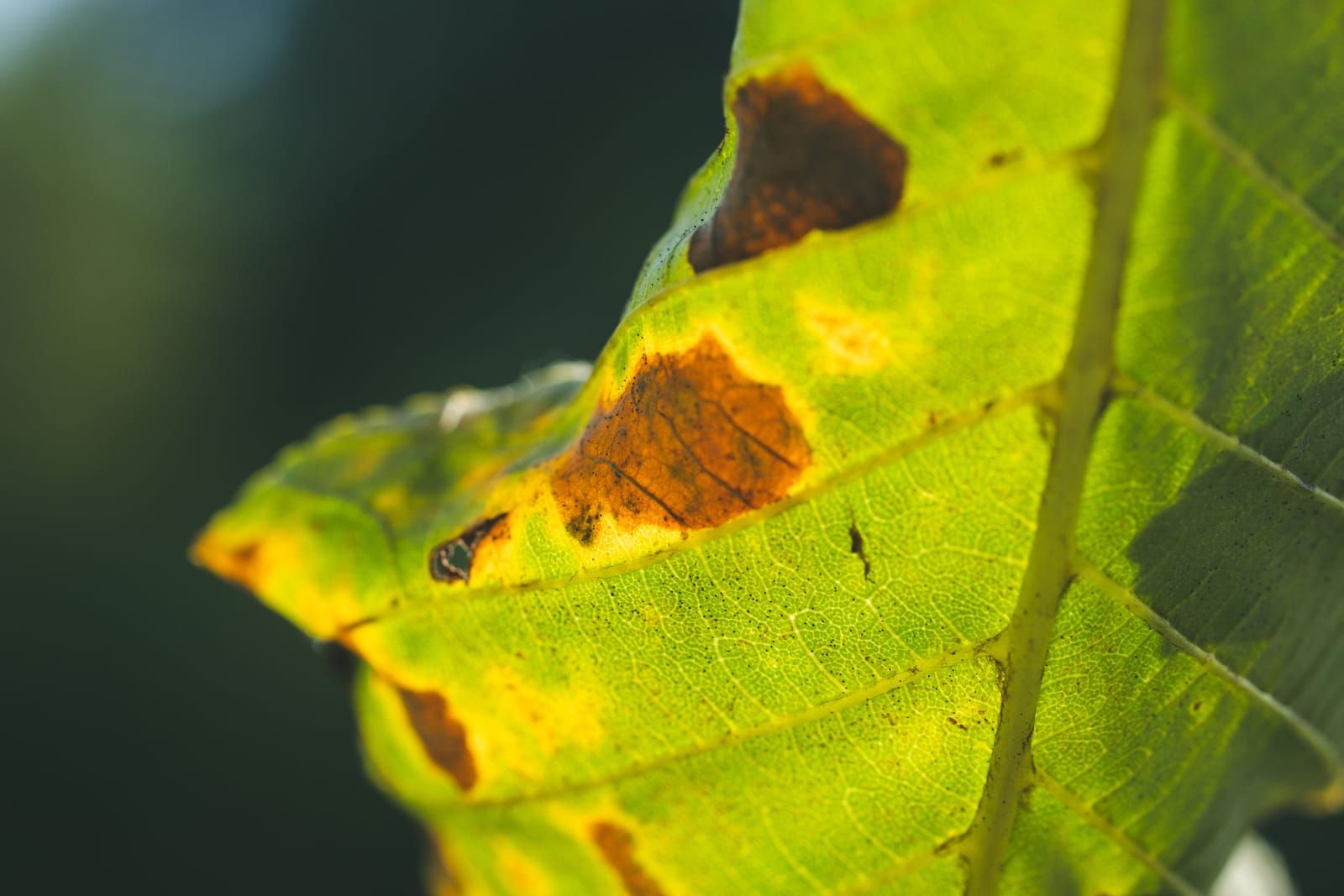
Distinct spots with an edge are usually a leaf-spot disease. Most are fungal, some are bacterial, and the pattern of the spot tells them apart: fungal spots are often round with a target-like ring or a yellow halo, bacterial spots look water-soaked and stop at the leaf veins, giving them an angular shape.
What usually causes it
- Fungal leaf spot and anthracnose. Round tan or brown spots, sometimes with a darker margin or a yellow halo, spreading in warm wet weather. Anthracnose makes larger sunken lesions along the veins.
- Black spot on roses. Black spots with feathery edges on rose leaves, the leaf yellowing around them and dropping early.
- Bacterial leaf spot. Small dark spots that look wet or greasy, bounded by the veins so they look angular rather than round. Often a yellow halo.
- Sunburn. Bleached or brown patches on the side facing the window or the sun, with no rings, no halo and no spread to shaded leaves. Common after a plant is moved outdoors in one go.
- Dry brown tips and edges. Crisp brown tips rather than spots. Low humidity, salt build-up from tap water and fertilizer, or erratic watering.
Check first
- Is the spot round or angular, and does it have a halo?
- Does it appear on shaded leaves too, or only where the sun hits?
- Are new spots still forming after a dry week?
White powder on the leaves
A dusty white coating that you can rub off with a finger is powdery mildew, one of the most common fungal diseases of houseplants, roses, squash, cucumbers and many shrubs. It thrives in warm days, cool nights and still air, and unlike most fungi it does not need wet leaves to spread.
What usually causes it
- Powdery mildew. White or gray powder on the upper leaf surface first, spreading to stems and buds. Leaves yellow, twist and drop as it advances.
- Downy mildew. The lookalike. Pale yellow patches on the upper surface with a gray or purplish fuzz on the underside, in cool damp weather.
- Mealybugs. White, but cottony rather than powdery, tucked into leaf axils and stem joints in tufts rather than spread as a film.
- Hard-water residue. A chalky film on leaves that have been misted or sprayed, in the pattern the droplets dried. Wipes off and never spreads.
Check first
- Rub a patch: does it come off as dust?
- Turn the leaf over: fuzz underneath means downy, not powdery.
- Is the air around the plant still and warm?
Curling or distorted leaves
Leaves curl to protect themselves. On new growth that usually means sap-sucking pests; on tomatoes it is often the plant reacting to stress; and a tight upward curl with yellowing edges on a tomato can be a virus carried by whiteflies.
What usually causes it
- Aphids. New leaves puckered and curled downward with a colony of small insects on the shoot tips and a sticky film below.
- Tomato leaf curl. Older leaves rolling upward and inward on a plant that is otherwise fine is physiological leaf roll after heat, drought or hard pruning. A virus looks different: stunted plants, small leaves curling upward with yellow margins.
- Thrips. New leaves distorted and streaked silver, with tiny black specks of frass. The insects are slender and hard to see without shaking the leaf over paper.
- Heat and thirst. The whole plant curls its leaves along the midrib in the afternoon and recovers by morning. Move it or water it, then watch.
- Herbicide drift. Twisted, cupped, strap-like new growth on plants near a treated lawn or path, appearing on several unrelated plants at once.
Check first
- Is it the new growth or the old growth that is curling?
- Shake a shoot over white paper and look for moving specks.
- Did it start after a heatwave, a move, or a hard prune?
Holes and chewed edges
Something is eating the plant, and the shape of the damage names it. Ragged holes with slime trails are slugs and snails; neat holes from the edge inward are caterpillars; small shot-holes across a leaf are flea beetles; and a pale winding line inside the leaf is a leaf miner.
What usually causes it
- Slugs and snails. Irregular holes, often in the middle of the leaf, with silvery slime trails on the leaf or the pot. Damage appears overnight.
- Caterpillars. Large sections eaten from the edge, dark pellets of frass on the leaves below, and usually the caterpillar itself on the underside.
- Leaf miners. Not holes but pale, winding tunnels or blotches inside the leaf, with the larva visible against the light.
- Flea beetles and weevils. Many tiny round holes across the leaf (flea beetles) or neat notches bitten from the edge (vine weevil adults).
Check first
- Go out with a torch after dark: most chewers feed at night.
- Look for slime trails, frass, or a tunnel you can see through when the leaf is held to the light.
Bugs, webbing, or sticky leaves
Sap feeders are the commonest houseplant pests, and most of them advertise themselves before you see the insect: a sticky film, a black sooty coating on the film, fine webbing between leaves, or a cloud of tiny white flies when the plant is touched.
What usually causes it
- Aphids. Colonies on the growing tips, sticky honeydew below, ants running up and down the stems.
- Spider mites. Fine pale stippling on the leaves, then a bronze cast and fine webbing in the leaf axils. Worst in hot dry rooms.
- Mealybugs. White cottony tufts in the joints and under the leaves, with honeydew and sooty mold.
- Whiteflies. Tiny white moth-like insects that rise in a cloud when the plant is disturbed, honeydew and sooty mold underneath.
- Fungus gnats. Small dark flies drifting up from the soil rather than the leaves, a sign of compost kept too wet.
Check first
- Wipe a leaf: sticky means honeydew, and honeydew means a sap feeder is above it.
- Hold a white sheet of paper under a leaf and tap it.
- Look in the leaf axils and along the midrib underneath, where most pests hide.
Wilting and drooping
A plant wilts when water is not reaching the leaves. Sometimes that is because there is none in the pot, but a wilting plant in wet soil has roots that cannot drink, whether from rot or from a wilt fungus blocking the stem.
What usually causes it
- Underwatering. Dry, light pot, soil shrunk from the sides, and a plant that perks up within hours of a soak.
- Root rot. Wet soil, a sour smell, brown mushy roots, and a plant that stays limp however much you water it.
- Fusarium wilt. Wilting that starts on one side or one branch, lower leaves yellowing, and brown streaks inside the stem when it is cut. Tomatoes, peppers, cucumbers and basil are the usual victims.
- Transplant shock and heat. A plant that was moved, repotted or scorched wilts for a day or two and recovers with shade and water.
Check first
- Is the soil dry or wet? Wilting in wet soil is the urgent one.
- Cut a small stem: a brown ring inside means a vascular wilt.
Mold or bugs on the soil
White fuzz on the compost surface is almost always a harmless saprophytic mold living on damp organic matter. Small dark flies rising from the soil are fungus gnats. Both are the same message: the compost is staying wet too long.
What usually causes it
- Fungus gnats. Adults drifting up when the pot is disturbed, larvae in the top few centimetres of soil, and seedlings or cuttings that wilt as their roots are nibbled.
- Saprophytic mold. White or gray fuzz on the soil surface that scrapes off and does not touch the plant. Let the surface dry and improve airflow.
- Gray mold. Fuzzy gray growth on dead or dying tissue, fallen petals and soft stems, spreading in cool damp air.
Check first
- Let the top 3 cm of compost dry out between waterings.
- Remove fallen leaves and petals from the soil surface.
What a scan adds to the checklist
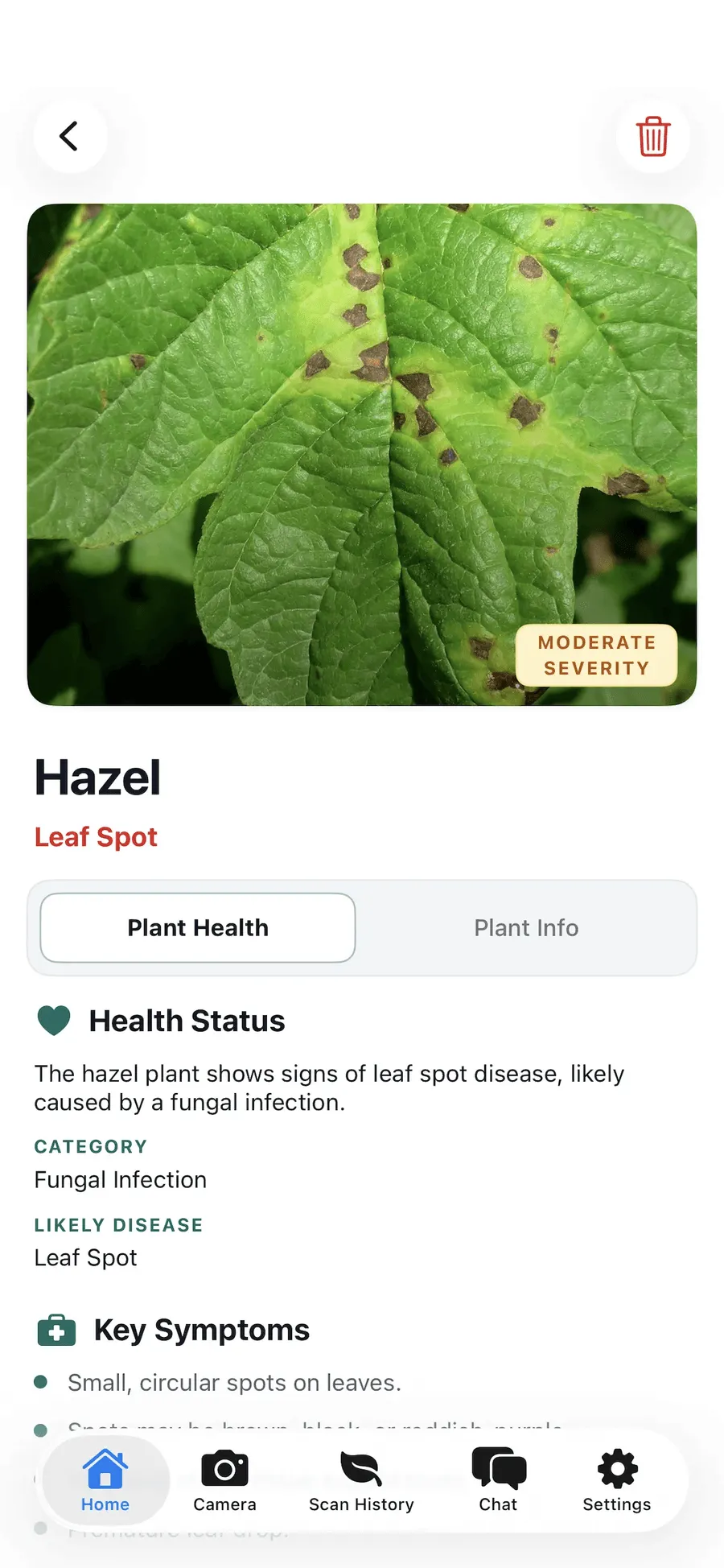
The checks above narrow the field. The scan settles it. Plant Sickness Identifier identifies the plant first, so the advice fits that plant, then reads the symptom and returns the most likely cause with its category, a severity rating and the key symptoms it found, so you can compare its reasoning with your own. The treatment plan starts with the gentlest step and moves up only if that fails.
Questions people ask
How do I tell what is wrong with my plant?
Start with the symptom you can see, then look at where it sits on the plant. Yellow old leaves point at water, light and feeding; brown spots with a halo point at a leaf-spot disease; a dusty white film is powdery mildew; curling new growth usually means sap-sucking pests. Then check the soil and the roots, because most houseplant problems begin below the surface.
Can a photo identify a plant disease?
Often, yes. Most common diseases and pests leave a recognizable pattern on the leaf, and a clear close-up captures it. Plant Sickness Identifier reads the plant, the symptom and its most likely cause from one photo and shows the match confidence, so you can see how cleanly it read. A problem that lives in the roots may need you to lift the plant out of its pot and photograph those instead.
Why are my plant's leaves turning yellow and falling off?
Yellowing that starts at the bottom and works upward on a plant sitting in wet soil is the classic sign of overwatering and the root rot it leads to. The same pattern on a plant that dries out completely between waterings is underwatering. Check the soil moisture with a finger before you change anything else.
When should I stop guessing and get help?
If a whole plant wilts in wet soil, if a stem shows brown streaks when cut, or if the same problem is spreading across several plants, act the same day: isolate the plant, lift it to check the roots, and scan it. Your local extension service or a plant clinic can confirm a diagnosis and advise on any chemical treatment.