- Type
- Pest
- Severity if untreated
- Low
- Peak season
- Runs through the warm growing season, with several generations following each other. Populations continue year round under glass.
- Also called
- leafminers, serpentine leafminer, leaf mining flies
Signs to look for
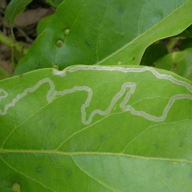
- Pale winding tunnels visible through the upper leaf surface as white or brown meandering lines.
- The tunnel widening along its length, because the larva grew as it fed.
- A thin dark frass trail inside the mine.
- Blotch-shaped irregular mines rather than tunnels, depending on the species involved.
- Mined areas turning brown and shriveling while the rest of the leaf stays green.
- Small creamy-white legless maggots or pupae at the end of the tunnels.
What it gets mistaken for
Fungal leaf spot. A leaf spot is a patch of dead tissue with a defined edge. A mine is a continuous path with a start and an end, and you can see it is hollow when you hold the leaf to the light.
Leaf scorch. Scorch browns margins and tips in a broad even sweep and never follows a winding track.
Caterpillar or snail feeding. Chewing pests remove tissue and leave holes or ragged edges. Leaf miners leave the leaf surfaces intact with the damage sealed inside.
Plants it affects
Chrysanthemum, gazania, Argyranthemum, Senecio cineraria and other daisy-family plants, Tomatoes, Lettuce and cole crops, Onions and garlic, Beets and chard.
How to treat it
From the gentlest step upward. Move to the next step only if the one before it has not worked within a week or two.
- Tolerate it in most cases. Affected plants usually survive and flower even when mining is extensive, and leaf miners are part of a balanced garden with their own natural enemies.
- Pick off mined leaves, or squeeze the end of the tunnel to crush the larva inside, which is the direct route since the larva is sealed between the leaf surfaces.
- Leave broad-spectrum insecticides alone. Parasitic wasps, including Diglyphus and Chrysocharis species, usually hold leaf miners below damaging levels unless those sprays remove them, and conserving them is the single most important part of leaf miner management.
- Where a susceptible crop needs protecting, grow it under insect barrier netting so the adult flies cannot lay eggs on the foliage in the first place.
- Clear affected leaves and crop debris at the end of the season so pupae do not carry over.
- If a treatment is being considered for a food crop, check your local extension service for what is registered and appropriate for that crop, and follow the product label.
How to keep it away
- Cover young susceptible plants with fine mesh before the adult flies are active.
- Keep broad-spectrum sprays out of the program so parasitoid wasps stay in place.
- Remove and dispose of mined leaves as they appear, rather than at the end of the season.
- Inspect new bedding and vegetable transplants, since mines arrive on nursery plants.
Related problems
- Aphids: Aphids are soft-bodied sap-feeding insects that gather in dense colonies on the newest growth.
- Spider mites: Spider mites are tiny sap-feeding arachnids that work on the undersides of leaves.
- Fungus gnats: Fungus gnats are small dark flies whose larvae live in the top few inches of constantly damp potting mix.
- Mealybugs: Mealybugs are slow-moving sap feeders that coat themselves in white wax.