
- Type
- Pest
- Severity if untreated
- Moderate
- Peak season
- Year round on indoor and greenhouse plants. Outdoors, populations build through the warm part of the growing season.
- Also called
- glasshouse mealybug, cottony mealybug
Signs to look for
- Fluffy white wax in leaf axils, branch crotches, stem joints and the crown of the plant.
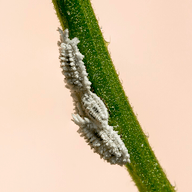
- Slow-moving oval insects under that wax, up to a few millimeters long, whitish from the waxy powder covering them.
- Sticky honeydew on leaves and on whatever sits beneath the plant.
- Black sooty mold growing on the honeydew.
- New growth stunted or yellowing while the colony is still small enough to miss.
- Colonies also on stems near the soil line, where they are easy to overlook.
What it gets mistaken for
Powdery mildew. Mildew is a flat dry powder spread over the leaf surface. Mealybug wax is lumpy and three-dimensional, concentrated in crevices, and there is an insect inside it.
Scale insects. Scales are hard or waxy immobile bumps stuck to stems and leaves. Mealybugs keep a loose fluffy covering and can crawl.
Whiteflies. Both make honeydew, but whiteflies fly. Mealybug females do not fly and barely crawl.
Plants it affects
Houseplants including dracaena, ficus, philodendron, schefflera, aglaonema, coleus, ferns and palms, Cacti, succulents, jade plants and African violets, Orchids and poinsettia, Citrus, grape vines, hibiscus, fuchsia, oleander and bird of paradise.
How to treat it
From the gentlest step upward. Move to the next step only if the one before it has not worked within a week or two.
- Isolate the plant. Mealybugs move between touching plants and along shared surfaces, and containment is most of the battle.
- Pick or prune out the colonies you can reach, taking the crevices where the wax is thickest.
- Wipe the remaining insects off with a damp cloth, or dab them with a swab of rubbing alcohol, which cuts through the waxy covering that makes them hard to treat.
- Wash the plant with a high-pressure or forcible spray of water, repeating every few days to catch the crawlers emerging from egg masses.
- Ease off nitrogen fertilizer, since the flush of soft new growth is what mealybug numbers feed on.
- If the colony persists, use insecticidal soap, horticultural oil or neem oil with thorough coverage of crevices and undersides, and repeat, because that wax repels a single pass. Follow the product label and check your local extension service for what is registered in your area.
- For a plant that is heavily infested throughout, replacing it is often the cleaner outcome. Under glass, the mealybug ladybird Cryptolaemus montrouzieri is the established biological control.
How to keep it away
- Quarantine new plants and inspect leaf axils and stem joints, which is where an arriving colony hides.
- Keep nitrogen fertilizer moderate so growth is steady rather than soft and rapid.
- Check the crevices of susceptible plants monthly, since a colony found small is a wipe-down rather than a campaign.
- Clean pots, trays and tools between plants so wandering crawlers have no bridge.
Related problems
- Aphids: Aphids are soft-bodied sap-feeding insects that gather in dense colonies on the newest growth.
- Spider mites: Spider mites are tiny sap-feeding arachnids that work on the undersides of leaves.
- Fungus gnats: Fungus gnats are small dark flies whose larvae live in the top few inches of constantly damp potting mix.
- Whiteflies: Whiteflies are small white sap-feeding insects that live on leaf undersides.