
- Type
- Pest
- Severity if untreated
- High
- Peak season
- Peaks in the hot, dry part of the year, and any time under glass or indoors where air is warm and dry. Populations reproduce fastest in hot weather.
- Also called
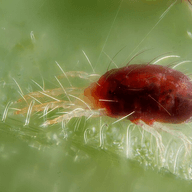
- two-spotted spider mite, red spider mite, glasshouse red spider mite
Signs to look for
- Fine pale mottling or stippling of light dots across the upper leaf surface, spreading leaf by leaf.
- Turn a leaf over and the undersides carry tiny moving specks plus white cast skins and egg shells.
- Leaves lose their green, take on a bronze cast, then dry and fall.
- Fine silk webbing over leaves, shoot tips and stems once numbers are high.
- Damage concentrated on plants that are dusty, crowded, or short of water.
What it gets mistaken for
Thrips. Thrips also strip color from leaves, but they leave silvery scarring plus small black fecal specks and never spin webbing.
Nutrient deficiency. Deficiency yellows whole zones of the leaf in a pattern set by the veins. Mite damage is a scatter of discrete pale dots, and the undersides carry mites.
Drought stress. A thirsty plant recovers its color after watering. Stippled tissue never recovers, because those cells are already emptied.
Plants it affects
Houseplants and greenhouse ornamentals, including fuchsias and orchids, Tomatoes, cucumbers, beans, squash and melons, Strawberries and other berries, Roses and other garden ornamentals, Fruit trees and vines.
How to treat it
From the gentlest step upward. Move to the next step only if the one before it has not worked within a week or two.
- Move the plant away from others first. Mites spread on contact, on hands and on tools, and an isolated plant is a contained problem.
- Wash the plant thoroughly, undersides included, with a forceful spray of water, and repeat it. Regular forceful spraying is named in extension guidance as a control in its own right, not just a clean-up.
- Fix the conditions they prefer: keep the plant properly watered, since water-stressed plants are highly susceptible, and damp down dusty paths and leaves nearby.
- Take off the worst leaves, the ones already bronzed and webbed, and bag them rather than shaking them out over other plants.
- Leave broad-spectrum insecticides alone. They routinely trigger mite outbreaks by killing the predatory mites and beetles that were holding numbers down.
- If the population is still climbing, use insecticidal soap or horticultural oil, covering leaf undersides completely, and repeat as the label directs, since eggs are not reached by a single pass.
- Under glass, the predatory mite Phytoseiulus persimilis is the standard biological control. For any product, follow the label and check your local extension service for what is registered in your area.
How to keep it away
- Keep plants watered and out of hot, dry, dusty corners. High temperatures, dry air and crowding are the conditions that turn a few mites into an infestation.
- Quarantine and inspect new plants, checking leaf undersides with a hand lens before they join a collection.
- Space plants so air moves between them, and clear out old debris, canes and ties before the growing season starts.
- Skip routine broad-spectrum sprays, which remove the natural enemies that keep mite numbers flat.
Related problems
- Aphids: Aphids are soft-bodied sap-feeding insects that gather in dense colonies on the newest growth.
- Fungus gnats: Fungus gnats are small dark flies whose larvae live in the top few inches of constantly damp potting mix.
- Mealybugs: Mealybugs are slow-moving sap feeders that coat themselves in white wax.
- Whiteflies: Whiteflies are small white sap-feeding insects that live on leaf undersides.