- Type
- Pest
- Severity if untreated
- High
- Peak season
- Peaks in warm weather and builds through the late part of the growing season outdoors. Populations continue year round in a heated greenhouse or indoors.
- Also called
- glasshouse whitefly, greenhouse whitefly
Signs to look for
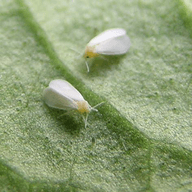
- A cloud of tiny white-winged insects flying up when the plant is disturbed, then resettling.
- Flat oval creamy-white scale-like nymphs packed on the undersides of leaves.
- Sticky honeydew on leaves, stems and fruit, and on the surface below the plant.
- Black sooty mold spreading over that honeydew.
- Leaves yellowing, silvering or drying, usually starting on the older growth.
- Some nymphs turned black, which means parasitic wasps are already working on the population.
What it gets mistaken for
Fungus gnats. Fungus gnats are dark, not white, and they come off the soil surface rather than off the leaves. They also leave no honeydew.
Aphids. Both leave honeydew and sooty mold, but aphid colonies stay put on the shoot tips when you shake the plant.
Mealybugs. Mealybugs are wingless and wrapped in fluffy wax in crevices, where whitefly nymphs are flat, bare and spread across the leaf underside.
Plants it affects
Tomatoes, peppers, cucumbers, melons and cole crops, Poinsettia, chrysanthemum, gerbera, pelargonium and fuchsia, Lantana, hibiscus and roses, Citrus, avocado, ash and mulberry.
How to treat it
From the gentlest step upward. Move to the next step only if the one before it has not worked within a week or two.
- Prune out isolated infested leaves as soon as you find them, which is the cheapest control there is when the population is still on a handful of leaves.
- Hose the adults off with a strong stream of water, working the undersides, and repeat.
- Hang yellow sticky traps to catch adults and, more usefully, to tell you whether numbers are rising or falling.
- For young plants outdoors, lay reflective mulch, which disrupts how whiteflies find the plant in the first place.
- Avoid broad-spectrum pyrethroids, organophosphates and neonicotinoids. They kill the parasitic wasps and predators that suppress whiteflies, and populations regularly rebound higher afterward.
- If treatment is needed, insecticidal soaps and oils have the least impact on those natural enemies, and they work by contact, so coverage of leaf undersides is the whole job. Follow the label and check your local extension service for what is registered where you are.
- Under glass, the parasitoid wasp Encarsia formosa is the standard biological control.
How to keep it away
- Quarantine new plants, since a greenhouse infestation usually arrives on a newly bought plant.
- Check leaf undersides weekly on the plants whiteflies favor, rather than waiting for the cloud.
- Clear out finished crops, old host plants and weeds, which carry the population between plantings.
- Keep broad-spectrum sprays out of the rotation so parasitic wasps stay in place.
Related problems
- Aphids: Aphids are soft-bodied sap-feeding insects that gather in dense colonies on the newest growth.
- Spider mites: Spider mites are tiny sap-feeding arachnids that work on the undersides of leaves.
- Fungus gnats: Fungus gnats are small dark flies whose larvae live in the top few inches of constantly damp potting mix.
- Mealybugs: Mealybugs are slow-moving sap feeders that coat themselves in white wax.