- Type
- Pest
- Severity if untreated
- Moderate
- Peak season
- Peaks in spring and early summer, when temperatures are warm but not hot. UC IPM puts the worst damage at 65 to 80 degrees Fahrenheit. Indoors, aphids stay active all year.
- Also called
- greenfly, blackfly, plant lice
Signs to look for
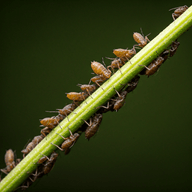
- Dense colonies of small soft-bodied insects on shoot tips, flower buds and the undersides of young leaves.
- New leaves curled, puckered or distorted while older leaves stay flat.
- A sticky film of honeydew on the leaves, stems or floor directly beneath the colony.
- Black sooty mold growing on that honeydew, on leaf surfaces and sometimes on fruit.
- White cast skins collecting on the upper surface of leaves under the colony.
- Ants running steadily up and down the stems, which is often what makes people look closely in the first place.
What it gets mistaken for
Whiteflies. Whiteflies leave the same honeydew and sooty mold, but the adults fly up in a white cloud when you shake the plant. Aphids stay put.
Mealybugs. Mealybugs are wrapped in white fluffy wax and sit in leaf axils and stem joints. Aphids are bare-bodied and crowd onto the growing tips.
Spider mites. Spider mites give you fine pale stippling and, in heavy attacks, silk webbing, with nothing visible enough to call a colony from arm's length.
Plants it affects
Roses, Plums, apples and pears, Crape myrtle and oleander, Tomatoes, peppers and beans, Lettuce, spinach and cucurbits, Indoor and greenhouse plants, where they carry on year round.
How to treat it
From the gentlest step upward. Move to the next step only if the one before it has not worked within a week or two.
- Look before acting. Lady beetles, lacewing larvae, hoverfly larvae and tan papery aphid mummies mean biological control is already running, and colonies often collapse on their own within a week or two.
- Squash the colonies between finger and thumb, or pinch out the few shoot tips carrying most of them.
- Knock the rest off with a strong stream of water, repeating every few days while new growth is soft. Aphids that fall rarely make it back.
- Stop feeding high-nitrogen fertilizer for the season. Soft, fast, nitrogen-rich growth is what aphid numbers track.
- Deal with the ants if they are present, since ants defend aphid colonies from the predators that would otherwise clear them.
- If numbers still climb, treat with insecticidal soap or horticultural oil, covering leaf undersides and growing points, since these products work by contact rather than by being taken up.
- Follow the product label for the plant you are treating, and check your local extension service for what is registered where you garden.
How to keep it away
- Keep nitrogen moderate. Extension guidance is blunt about this: never use more nitrogen than the plant needs.
- Inspect new plants before they join the rest, especially the growing tips and the undersides of the youngest leaves.
- Leave broad-spectrum insecticides alone so the predators and parasitic wasps that hold aphids down survive.
- Check growing points weekly through the flush of new growth, when a colony is still a dozen insects rather than a sheet of them.
Related problems
- Spider mites: Spider mites are tiny sap-feeding arachnids that work on the undersides of leaves.
- Fungus gnats: Fungus gnats are small dark flies whose larvae live in the top few inches of constantly damp potting mix.
- Mealybugs: Mealybugs are slow-moving sap feeders that coat themselves in white wax.
- Whiteflies: Whiteflies are small white sap-feeding insects that live on leaf undersides.