- Type
- Pest
- Severity if untreated
- Moderate
- Peak season
- Builds through the warm part of the growing season, with generations following each other quickly. Populations continue year round in a heated greenhouse.
- Also called
- western flower thrips, onion thrips, thunderflies
Signs to look for
- Silvery or scabby flecked scarring on leaves, petals and fruit, often described as looking bleached.
- Small dark specks of excrement dotted across the scarred areas.
- New shoots and leaves distorted, curled or scarred as they expand.
- Flower buds that deform and fail to open, or petals that open already streaked.
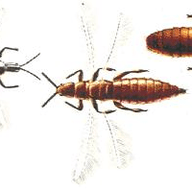
- Thin pale or dark insects that run for cover when you shake a flower over white paper.
What it gets mistaken for
Spider mites. Mites give even stippling and, when numbers are high, silk webbing. Thrips leave larger silvery patches plus black fecal specks and never webbing.
Virus infection. A virus distorts and mottles leaves without the silvery scarring or fecal specks. It also does not improve as new growth comes through clean.
Nutrient deficiency. Deficiency changes color in patterns set by the leaf veins, uniformly across the plant, with no scarring texture when you run a finger over the leaf.
Plants it affects
Roses, impatiens, petunias, chrysanthemums and gerbera, Peppers, cucurbits and onions, Strawberries, blueberries and grapes, Citrus and avocado, Azalea and laurel fig.
How to treat it
From the gentlest step upward. Move to the next step only if the one before it has not worked within a week or two.
- Prune out injured and infested terminals and pick off spent flowers, which is where the population is concentrated and where sprays cannot reach.
- Put out bright yellow sticky traps to detect adults and to track whether numbers are moving.
- Cut back on nitrogen fertilizer, since excessive applications are noted to promote higher thrips populations.
- Hose the foliage to dislodge what is exposed, and clear weeds around the growing area that serve as alternate hosts.
- Cover young or susceptible plants with fine mesh or row cover before thrips arrive, which is more effective than treating afterward.
- Contact products such as horticultural oils, insecticidal soaps and neem work only on what they touch, and thrips feed inside closed buds and pupate in the soil, so expect repeat applications and partial results. Follow the label and check your local extension service for what is registered in your area.
- Conserve natural enemies, including minute pirate bugs and predatory mites, by keeping persistent broad-spectrum pesticides out of the program.
How to keep it away
- Inspect flowers and new growth on incoming plants, shaking a bloom over white paper to see what falls out.
- Remove old flowers and plant debris promptly so populations do not carry over.
- Control weeds around the growing area, which act as reservoirs between crops.
- Keep nitrogen moderate and growth steady rather than lush.
Related problems
- Aphids: Aphids are soft-bodied sap-feeding insects that gather in dense colonies on the newest growth.
- Spider mites: Spider mites are tiny sap-feeding arachnids that work on the undersides of leaves.
- Fungus gnats: Fungus gnats are small dark flies whose larvae live in the top few inches of constantly damp potting mix.
- Mealybugs: Mealybugs are slow-moving sap feeders that coat themselves in white wax.