- Type
- Fungal disease
- Severity if untreated
- Moderate
- Peak season
- Worst after prolonged cool, wet weather in spring, when new leaves are expanding. Fruit and vegetable infections follow warm, humid, rainy stretches in the growing season.
- Also called
- leaf and twig blight, anthracnose fruit rot
Signs to look for
- Dark lesions on leaves, developing along the major veins on trees such as sycamore and oak.
- Young leaves curled and distorted, with only a portion of each leaf dying rather than the whole thing.
- Heavily infected leaves falling early, continuing through the growing season rather than all at once.
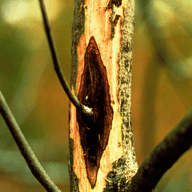
- Sunken lesions and cankers on twigs and stems.
- On vegetables and fruit, roughly circular sunken spots that darken in the middle, carrying pinkish spore masses in moist weather.
What it gets mistaken for
Leaf scorch. Scorch browns leaf margins and tips evenly across the exposed side of the plant. Anthracnose lesions follow the veins and appear throughout the canopy.
Frost damage on new growth. Frost damage all appears at once on the growth that was exposed, then stops. Anthracnose keeps producing new lesions through wet weather.
Bacterial leaf spot. Bacterial spots start water-soaked and angular, often with a yellow halo, and lack the sunken cankers on twigs.
Plants it affects
Sycamore, oak, ash, maple, dogwood and Chinese elm, Cucumbers, melons and squash, Tomatoes and peppers, Beans.
How to treat it
From the gentlest step upward. Move to the next step only if the one before it has not worked within a week or two.
- Rake up and dispose of fallen leaves and twigs during the growing season, which removes the inoculum that reinfects the canopy.
- Prune out dead and diseased twigs in winter, which also increases air circulation through the canopy.
- Switch irrigation so it does not wet the leaves, since the fungus needs water to spread and infect.
- Stay out of the planting while the foliage is wet, and avoid moving tools or equipment through wet plants.
- For vegetables, plant certified disease-free seed, give plants full sun and ample spacing, use well-drained ground, and rotate away from the affected crop family for at least a year and preferably two or three.
- Where a fungicide is warranted, it works preventively, applied before wet periods with complete spray coverage, not as a cure for lesions already present. Follow the product label and check your local extension service for what is registered in your area.
How to keep it away
- Space and prune for an open canopy so foliage dries quickly.
- Irrigate at ground level rather than overhead, and avoid sprinklers on susceptible trees.
- Clear fallen leaves, twigs and crop debris rather than leaving them under the plant.
- Rotate vegetable crops and start from disease-free seed.
Related problems
- Powdery mildew: Powdery mildew is a fungal disease that grows on the outside of leaves as white powdery patches.
- Black spot (roses): Black spot is the defining rose disease, caused by the fungus Diplocarpon rosae.
- Root rot: Root rot is what follows when roots sit in saturated soil.
- Fusarium wilt: Fusarium wilt is a soil-borne fungus that enters through the roots and blocks the plant's water-conducting tissue.