- Type
- Water mold
- Severity if untreated
- High
- Peak season
- Peaks in cool, wet, humid stretches: the shoulder seasons outdoors and any damp spell under glass. Extension guidance puts the favorable range at roughly 58 to 72 degrees Fahrenheit with humidity above 85 percent at the leaf surface.
- Also called
- downy mildews, false mildew
Signs to look for
- Pale green, yellow, purple or brown blotches on the upper leaf surface, often angular because the veins bound them.
- Turn the leaf over and the matching patch carries fuzzy growth, white to bluish-white at first, darkening to gray or purple.
- Older and lower leaves affected first, working upward.
- Blotches turning brown and drying as the leaf tissue dies.
- Rapid spread through a planting after a spell of humid weather or extended leaf wetness.
What it gets mistaken for
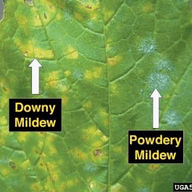
Powdery mildew. Powdery mildew is a white bloom sitting on top of the leaf and spreads in dry humid conditions. Downy mildew's growth is underneath, and it needs leaf wetness.
Fungal leaf spot. Leaf spots are round with defined borders and no fuzz underneath. Downy mildew blotches have straight vein-bounded edges and a matching fuzzy patch below.
Nutrient deficiency. Deficiency yellows between veins across the whole plant evenly, with nothing growing on the underside of the leaf.
Plants it affects
Lettuce, spinach, brassicas, peas, parsnips and onions, Cucumbers, melons and squash, Impatiens, pansies, snapdragons, columbine and Rudbeckia, Roses and grapevines.
How to treat it
From the gentlest step upward. Move to the next step only if the one before it has not worked within a week or two.
- Remove affected leaves promptly and take them out of the growing area rather than composting them in place.
- Open the planting up. Space plants so leaf surfaces dry quickly, since dense planting and extended leaf wetness are the conditions the disease needs.
- Water at the base, early in the day. Overhead irrigation during cool weather is specifically what extension guidance tells growers to avoid.
- Stop working among wet plants, which moves spores from leaf to leaf on hands and clothing.
- Rotate away from the affected crop family and plant resistant cultivars where they exist, for lettuce, onions and some impatiens among others. Resistance can break down over time as the pathogen changes.
- If a treatment is used, choose one whose label names downy mildew specifically. These are oomycetes rather than true fungi, so a product aimed at powdery mildew is not the same tool. Follow the label and check your local extension service for what is registered in your area.
How to keep it away
- Space and thin plantings so air moves and leaves dry fast after rain or dew.
- Water the soil rather than the foliage, and water early enough that anything wet dries before evening.
- Rotate crops and clear infected debris at the end of the season.
- Scout susceptible plants through cool humid spells, checking leaf undersides rather than waiting for blotches above.
Related problems
- Powdery mildew: Powdery mildew is a fungal disease that grows on the outside of leaves as white powdery patches.