White fuzz on potting soil is usually a saprotrophic fungus, a decomposer that eats dead material in the mix and does not attack living plants. Fungus gnats are a separate organism entirely, small dark flies whose larvae live in the same damp surface. One is scenery. Both are telling you the mix stays too wet.
That is the whole answer, and it is worth saying plainly because the two get searched as if they were one problem. They are not. They are two unrelated organisms that happen to arrive for the same reason, which is why treating the fuzz does nothing about the flies, and why the one change that fixes either of them fixes both.
What is the white fuzz on my potting soil?
Saprotrophic fungi decompose dead organic material and break it down into humus, minerals and nutrient resources that plants can use, as the Royal Horticultural Society puts it. They live on material that is already dead: fallen leaves, bark, log piles, and, the RHS specifies, the soil surface, bark mulches and compost. A bag of commercial potting mix is largely dead organic matter, so a fungus turning up to decompose it is the system working rather than failing.
The RHS position on control is direct. In the majority of cases, saprotrophic fungi growing in gardens do not need to be controlled. They are described as allies in recycling organic matter, not as a threat to a living plant.
What you see is the visible part of that, a thin cottony or powdery film across the surface, usually white, sometimes faintly yellow or gray, appearing after a warm humid stretch and often disappearing on its own when the surface dries. Scrape it off if you dislike it. Scraping is cosmetic and it will come back if nothing else changes, because what brought it is the moisture, not bad luck.
One lookalike is worth ruling out first. Clemson’s Home & Garden Information Center notes that white to grey crusty deposits on the soil surface or the rim of pots are a sign of salt buildup from fertilizer and tap water, and specifically warns not to confuse that with the white or yellow mold-like growth of saprophytic soil fungi. The difference is texture. Salt is a hard crust that crumbles and feels gritty. Fungus is soft, fibrous and smears.
Is it mold or is it fungus gnats?
If something is moving, it is not the fungus.
Fungus gnats are, in UC IPM’s description, dark, delicate-looking flies similar in appearance to mosquitoes, about one sixteenth to one eighth of an inch long, with slender legs and segmented antennae longer than their head. Colorado State University Extension describes them as weak fliers that typically fly in short, erratic patterns. UC IPM notes that indoors they usually do not move around much and tend to remain near potted plants, while being attracted to light, which is why people often notice them at a window first rather than at the pot.
So the test is behavioral, and it takes a few seconds. Brush the plant or water it, then watch the soil surface. Fuzz stays still. Gnats drift up out of the pot in a loose, wobbling flight and settle back onto the surface or run across it. That distinction is reliable enough that you do not need to catch one to be sure.
Fruit flies are the other thing people mean when they say gnats, and they sort out just as quickly by location: they belong to ripe fruit and drains, not to pots. Shore flies come off wet soil too, but UC IPM separates them on the antennae, which are short and bristle-like rather than long. The fungus gnats guide sets out the full lookalike list with the identifying details for each.
Here is the connection between the two halves of this post. Colorado State states that fungus gnat larvae feed on algae, fungi and plant roots in the growing medium, and UC IPM’s list of what the larvae consume includes organic mulch, leaf mold, grass clippings, compost, root hairs and fungi. The fungus in the mix is literally food for the larvae. Persistent surface fuzz and a gnat population are two readings of the same instrument.
Do fungus gnats actually hurt the plant?
Mostly, no. UC IPM is clear that adult fungus gnats do not damage plants or bite people, and that their presence is primarily considered a nuisance. Colorado State agrees that the adults do not bite and do not feed on plants.
The larvae are where the qualified answer lives. UC IPM says that when present in large numbers they can damage roots and stunt plant growth, particularly in seedlings and young plants, and can cause wilting in severe cases. So a handful of gnats around an established monstera is an annoyance, while the same population in a tray of seedlings is a real problem. Judge it by what is growing in the pot, not by the number of flies at the window.
They compound quickly if the conditions hold. UC IPM puts a generation, female to female, at about seventeen days depending on temperature; Colorado State puts the egg-to-adult cycle at three to four weeks at typical room temperatures of 65 to 75 degrees Fahrenheit, running continuously indoors year round.
What about the little yellow mushrooms?
A bright yellow mushroom pushing up through a houseplant pot is the same story in a more dramatic form. Penn State Extension’s Master Gardener program covers Leucocoprinus birnbaumii, the flower pot parasol, also called the yellow houseplant mushroom, describing it as a saprotrophic fungus that thrives on decaying organic matter, leaf litter, compost and commercial potting soils.
Penn State states plainly that it will not harm a houseplant. It also notes that the fungus has medium severity poison characteristics, with symptoms including mild to severe diarrhea, vomiting, nausea and other gastrointestinal upsets, which matters in a house with a toddler or a dog that chews things. Remove the mushrooms in that situation; the reason is the household, not the plant. And Penn State reads the same signal the fuzz gives: the fungus prefers warm, moist conditions, and its regular appearance indicates the soil is too moist and the plant is being overwatered.
The thing worth actually worrying about
None of the organisms above is the problem. The problem is the condition all three are reporting, which is a growing medium that never dries out. That same condition is what root rot needs, and root rot is not cosmetic: it kills plants while the owner keeps watering them, because a plant with failing roots wilts exactly like a thirsty one. The distinction, and how to check the roots, is in the root rot guide, and the soil-surface entry in the symptom checker covers what else shows up on top of the mix.
What to change
Both extension sources put the same step first, and it is not a product.
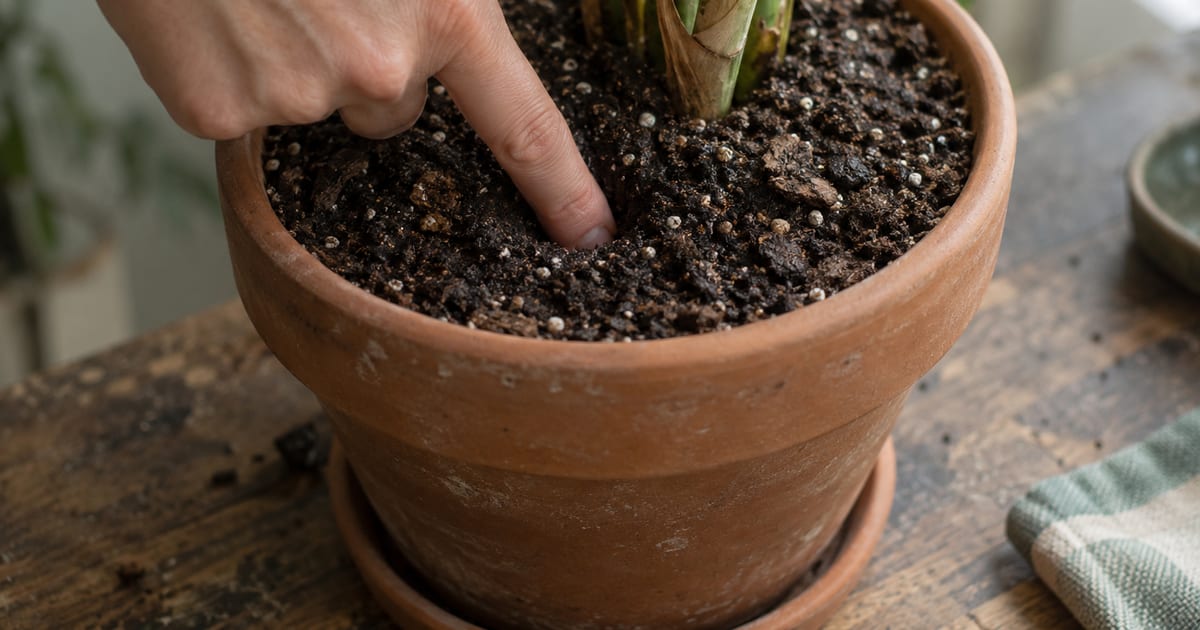
- Let the surface dry between waterings. UC IPM advises allowing the surface of container soil to dry between waterings and providing good drainage. Colorado State is more specific: let the growing medium dry between watering, especially the top one to two inches. That single change removes what the larvae eat and what the fungus decomposes.
- Fix the plumbing. Empty saucers and decorative outer pots, and confirm the pot drains rather than holding water at the bottom.
- Confirm before treating. UC IPM notes that raw potato chunks placed in the soil are very attractive to fungus gnat larvae, which makes a potato slice a free way to find out whether larvae are actually present.
- Use yellow sticky traps to monitor. Both sources list them for catching adults, and their real value is telling you whether numbers are falling.
- If larvae need treating, the standard options in both sources are soil drenches of Bacillus thuringiensis subspecies israelensis, which UC IPM describes as temporary control requiring repeated applications, and the nematode Steinernema feltiae, which UC IPM says can provide season-long control after several initial applications. Rates, registration and product choice belong to the label and your local extension service, not to an article.
If you are looking at a pot and cannot tell whether the film on top is fungus, a salt crust or something on the plant itself, a photo of the surface and one of the plant will let Plant Sickness Identifier sort the surface film from an actual disease and flag whether the watering pattern is the thing to change. That is the useful question here, because the fuzz almost never is.
Sources
- Saprotrophic Fungi in Gardens, Royal Horticultural Society
- Pest Notes: Fungus Gnats, UC Statewide IPM Program, UC ANR Publication 7448
- Fungus Gnats as Houseplant and Indoor Pests (5.584), Colorado State University Extension
- Houseplant Diseases & Disorders, Clemson Cooperative Extension Home & Garden Information Center
- The Invasion of the Flower Pot Parasol, Penn State Extension Master Gardener Program