
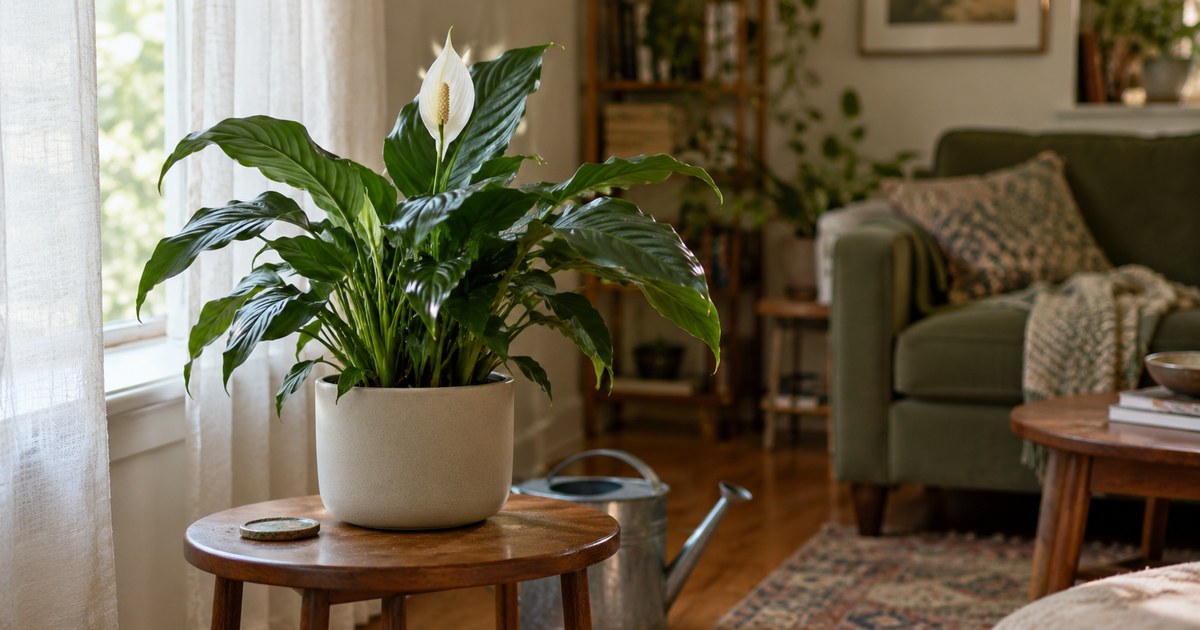
A peace lily drooping is dramatic. The whole plant folds over in an afternoon, every leaf flat against the pot. Most of the time it is simply thirsty, and the plant is known for exactly this. The useful question is not why it drooped but what it does after you water it, because the recovery, or the lack of one, is what separates the harmless case from the one that matters.
A peace lily drooping in dry potting mix is thirsty, and the UF/IFAS guidelines for the plant say it will stand back up within a matter of hours of a thorough watering. A peace lily drooping in mix that is still wet, and staying down after watering, has roots that can no longer take up water, which usually means overwatering.
That is the split. The rest of this post works through the thirst case, the wet case, and the two less common causes, cold and light, with the check for each.
The wilt that recovers in hours
The University of Florida’s cultural guidelines for Spathiphyllum, written for the people who grow it commercially, call underwatering the most common problem with the plant indoors, causing the entire plant to wilt severely, something the trade calls a crash. The fix they give is almost disappointingly simple: thorough watering, after which the plants resurrect in a matter of hours. The University of Maryland Extension’s watering guide names the peace lily specifically as a plant that wilts when it needs to be watered, and Clemson’s Home & Garden Information Center says that if the soil is allowed to dry out excessively the plant will wilt and the leaves and edges will turn yellow.
The check. Before watering, push a finger into the mix. Maryland suggests testing to a depth of about two inches, and adds a second test that works well on a peace lily in a plastic pot: lift the plant, pot and all, because a pot with dry mix weighs much less than one still holding water. Dry two inches down and light in the hand is the thirst picture.
The change. Water thoroughly, until it runs from the drainage hole, and then watch. If the leaves are back up by evening, the plant was thirsty and nothing else. The lesson is in the routine rather than the plant: the mix went too far between waterings. SDSU Extension and NC State both describe the target as moist but not soggy, allowed to dry only slightly between waterings, and NC State notes that watering from below works very well for peace lilies. Repeated crashes carry a cost, though. The Florida guide warns that chlorosis or dead leaf tissue can show up after a plant recovers, so a peace lily that is allowed to collapse every week will look progressively worse even though each collapse is survivable.
The wilt that does not recover
The same plant can wilt for the opposite reason. Maryland’s watering guide says it in one sentence: peace lilies wilt when they need water, although plants can also wilt if they are overwatered. The Florida guide describes the overwatered plant as one whose leaves wilt or collapse and sometimes develop dead tissue along the margins, with roots that are sparse, sometimes with black tips, and gives the remedy as watering less often so the mix can hold air. Clemson and SDSU both say root and stem diseases in peace lilies are associated with overwatering, and Clemson adds the single habit that causes most of it: never let the plant sit in a saucer of excess water, as this leads to root rot.
The check. This is where the finger test earns its place, because it is done before watering rather than after. A drooping peace lily whose mix is still damp two inches down, in a pot that is heavy in the hand, is not thirsty. Watering it will not bring it back up, and the leaves may begin to yellow as well as droop; Maryland’s guide describes the too-wet plant as one that drops leaves or turns yellow, while the too-dry plant wilts and turns gray-green. Tip the plant out and look at the roots. Pale, firm roots that fill the pot are healthy. Few roots, dark or soft, with a sour smell, are the rot picture, and the root rot guide shows what each looks like across houseplants.
The change. Let the mix dry down to slightly damp before watering again, empty the saucer every time, and make sure the pot drains. A plant with mostly rotted roots needs the dead material cut away and fresh mix in a pot that drains, and it may lose leaves while it regrows roots. The overwatered plant symptoms post explains in more detail why a drowning plant looks exactly like a thirsty one.
Drooping after a cold night or a draft
Peace lilies are tropical, and the sources describe cold damage rather than a clean wilt. The Florida guide lists cold and drafts, or extended periods below 45 degrees Fahrenheit, as a cause of stunted growth and black areas on the leaves, with the injury usually beginning at the leaf tips. NC State says temperatures between 40 and 60 degrees slow growth considerably, and that extended periods below 40 degrees damage leaves, stems and roots. Clemson advises avoiding temperatures below 60 degrees because cold damage may occur, and SDSU says to avoid any spot at 55 degrees or lower. Clemson also warns against placing the plant where heating or air-conditioning vents blow directly on it, since hot, cold or drafty exposure will damage it.
The check. Look at where the plant stands and what changed. A peace lily that went downhill after a cold night on a windowsill, a move from a warm shop to a cold car, or the arrival of a draft from a newly opened vent, with the mix still moist, points at temperature rather than water, and darkening leaf tips are where the Florida guide says the injury begins.
The change. Move the plant away from the glass and out of the path of any vent, into the 65 to 80 degree range SDSU recommends. Cold-damaged tissue does not recover, so judge the fix by the new leaves rather than the old ones.
Drooping in a bright window
The last cause is the one that looks most like thirst. NC State puts the plant’s preferred light at partial to deep shade and says not to place it in direct sun; Clemson says direct sun will scorch the foliage. The Florida guide notes that excessive light causes leaf curling and paleness, and says plants may droop late in the day in bright light when temperatures are above 80 to 85 degrees even though the mix is moist, that this is normal, and that frequent drooping of this kind will result in brown tips and edges.
The check. A plant that droops in the afternoon in a sunny window and recovers by evening without being watered is responding to heat and light. The leaves will often be paler than a peace lily’s normal deep green, and the mix will not be dry.
The change. Move it back from the window or behind a sheer curtain. SDSU describes bright, indirect light as the best match for the shade the plant grows in naturally.
Reading the leaves alongside the wilt
Two secondary signs help. Yellow leaves with the wilt point toward the watering extremes: SDSU says yellow leaves occur if the plant is overwatered or underwatered, and the yellow leaves post ranks the causes in the order to check them. Brown tips and edges point to a longer-running issue rather than today’s wilt: SDSU attributes them to excessive light, overfertilizing, low water or low humidity, and Clemson adds that overfertilizing can burn the leaf tips and roots.
What to check, in order
- Is the mix dry or wet two inches down? Dry means thirsty. Wet means roots.
- Does it recover within hours of a drink? Yes means thirst. No means look at the roots.
- What changed? A cold night, a draft, a move to a sunny window.
- Are the leaves yellowing or browning as well? That points to the routine rather than the day.
Most peace lilies that droop are thirsty and most of the rest are wet, and the finger test before watering sorts them. The hard case is the plant that has been both, dried out and then overwatered in apology, so that the mix is wet and the roots are already damaged. A photo of the whole plant and one of the roots lets Plant Sickness Identifier read the wilt pattern against the common causes and say which it matches most closely, and a scan a week after the routine changes shows whether the new leaves are standing up on their own. The wilting section of the symptom checker covers the same wet-or-dry split for other houseplants.
Sources
- Cultural Guidelines for Commercial Production of Interiorscape Spathiphyllum (ENH958/EP161), UF/IFAS Extension
- Watering Indoor Plants, University of Maryland Extension
- Peace Lily, Clemson Cooperative Extension Home & Garden Information Center
- Peace Lily: Houseplant How-To, South Dakota State University Extension
- Spathiphyllum (Peace Lily, Spathe Flower, White Sails), North Carolina Extension Gardener Plant Toolbox, NC State Extension