
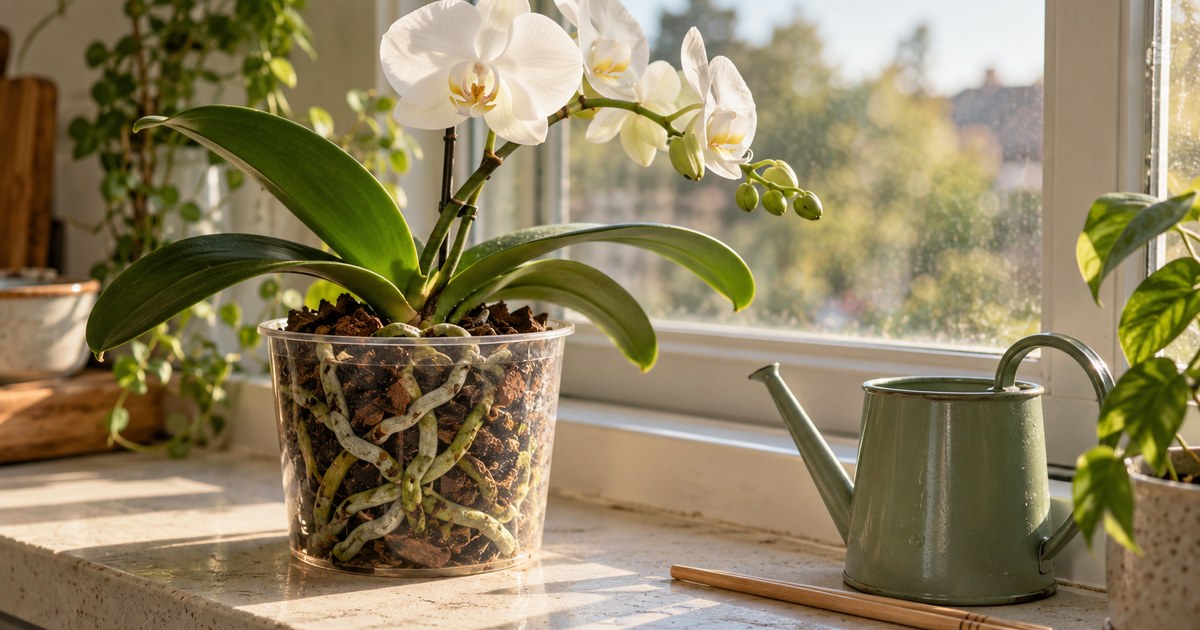
Orchid leaves turning yellow are read by position before anything else. On a moth orchid, which is the orchid most people own, the plant carries only a handful of leaves stacked on a short stem, so which leaf has gone yellow is obvious at a glance, and it is the most useful thing to notice.
Orchid leaves turning yellow are usually one of three things. A single bottom leaf yellowing on its own is normal aging. Yellowing across newer leaves, with a wet mix and brown roots, points to overwatering. Yellow-green leaves with reddish edges point to too much light. A yellow, soft center leaf is the one case to act on quickly.
The rest of this post takes each pattern in turn, with the check that confirms or rules it out. Most moth orchids live in clear plastic pots, which makes the root check unusually easy, and the roots are where the real answer is.
The bottom leaf is yellow and the rest are fine
This is the pattern to rule out first, because it needs no action. The University of Maryland Extension’s Maryland Grows column says plainly that it is normal for the oldest leaves of moth orchids (Phalaenopsis) to turn yellow and dry up as they age. The oldest leaf is the lowest one, so a plant that is otherwise firm and green, losing one lower leaf while a new leaf grows from the center, is doing what moth orchids do.
The check. Count how many leaves are affected and where they sit. One leaf, at the bottom, drying from yellow to papery while the leaves above stay firm and green, is the normal case. Maryland’s phalaenopsis care sheet simply advises cutting off any old yellowed leaves at the base of the plant.
The change. None. Let the leaf drop or trim it once it is dry.
Several leaves are yellowing, and the mix is wet
Yellowing that moves beyond the oldest leaf is the pattern that matters. The Maryland Grows column draws the line clearly: uniform yellowing and shriveling of newer leaves signals that the plant is in distress, and the usual reason is that the roots are no longer taking up water, whether from overwatering and root rot or from an old, degraded potting medium that has become too dense. Iowa State University Extension puts root rot in orchids down to the same thing, describing it as almost always caused by too much water.
The check. Look at the roots through the pot. Iowa State says healthy orchid roots are green or white and plump, while brown, shriveled roots are an indication of potential root rot. Dead roots alone do not say which way the watering went wrong; the state of the bark does. If the pot is opaque, lift the plant out; moth orchids sit loosely in bark and come out easily. Then check how wet the bark is. Iowa State describes dry media as lighter in color and weight, and suggests pushing a wooden chopstick into the mix: it comes out completely dry when the plant is ready for water. Bark that is still dark and heavy days after watering, with roots going brown and soft, is the overwatering picture.
The change. Water less often and more thoroughly. The Maryland care sheet describes running warm water over the plant, bark and aerial roots in a series of drenches over about ten minutes, and says that under normal home temperatures watering should not be needed more than once a week. Iowa State adds the detail that stops most orchid root rot in the first place: empty saucers, trays or outer pots within 30 minutes, and never let the plant sit in water. The Royal Horticultural Society gives the same warning and adds that overpotting, moving the plant into a pot that is too large, lets excess compost hold moisture and encourages root rot.
If the roots are mostly brown and mushy, the plant needs repotting into fresh bark with the dead roots trimmed away. The root rot guide covers what rotted roots look like across houseplants, and the overwatered plant symptoms post explains why a plant with rotted roots can look thirsty.
The leaves are yellow-green and the plant is by a sunny window
Light changes the color of the whole leaf rather than one leaf at a time. The Maryland care sheet says moth orchids receiving the proper amount of light have light green leaves, that low light produces dark green leaves that feel very stiff, and that under very high light the leaves develop a pink or reddish color along the margins and appear yellow-green or almost yellow. Iowa State says the same: leaves turn yellow-green or sometimes red in too much light, and a medium grassy green indicates adequate light.
The check. Compare the leaf color to the position. A plant that has gone yellow-green all over, with reddish leaf edges, in a window with direct sun on it, is showing a light response rather than a root problem. The roots will still look green or white and plump. Iowa State notes that damage from excessive light can progress quickly and eventually produce white, then brown, dead patches, and the RHS says to keep moth orchids out of direct summer sun because it can scorch the leaves.
The change. Move the plant back from the glass or filter the light with a sheer curtain. Iowa State says to avoid hot exposures, and that east and south-facing windows are usually best, with a sheer curtain doing the work in a south window. The yellow-green tint fades over weeks as the plant adjusts; any white or brown scorched patch is permanent, so judge the fix by the new leaf.
The top leaf, or the center of the plant, is yellow and soft
This is the one position that is not routine. A moth orchid grows from a single growing point at the center, where the newest leaf emerges. If that center turns yellow or brown and goes soft, while the lower leaves are still green, the problem is at the crown rather than the roots. Iowa State describes a decay and collapse of the plant near the crown as the end point of rot, and the Maryland Grows column explains the usual cause when it starts at the center: bacterial rot can occur if water is allowed to sit around the center shoot or in the leaf sheaths.
The check. Look into the center of the plant after watering. Water sitting in the cup where the newest leaf emerges, or in the folds where leaves meet the stem, is the condition that lets the rot start. A center that is firm and green is fine, however the lower leaves look.
The change. Water in the morning so the plant dries by night, which is the Maryland Grows advice, and tip or blot out any water that collects in the crown. A plant whose growing point has already rotted cannot grow new leaves from that point, so the preventive habit is the one that counts.
The leaves are yellowing and wrinkled
Yellow with a wrinkle in it points the other way from the wet-mix case. Iowa State lists shriveled, misshapen, accordion-folded, limp and leathery leaves as symptoms of insufficient water, and the RHS says roots that are kept too dry may shrivel and die. The catch, as the Maryland Grows column points out, is that a plant with rotted roots also cannot take up water, so a wrinkled leaf can appear on an overwatered plant too.
The check. The roots settle it. Silvery, dry, shriveled roots in bone-dry bark point to underwatering. Brown, mushy roots in wet bark point to overwatering, with the wrinkle a secondary effect. The Maryland care sheet gives a useful live signal: a moth orchid’s aerial roots turn from dull silver or white to pale green when they have taken up enough water.
The change. For a dry plant, give the thorough drench described above and then settle into the once-a-week-or-less rhythm, checking the bark rather than the calendar.
What to check, in order
- Which leaf? The bottom leaf alone is normal. Several leaves, or the center, is not.
- What color are the roots? Green or white and plump is healthy. Brown and mushy is wet. Silver and shriveled is dry.
- Is the bark wet or dry? Weight, color and the chopstick test.
- Where is the plant? Direct sun turns the whole plant yellow-green with red edges.
- Is there water in the center? Check after every watering.
A moth orchid in a clear pot shows most of this through the pot wall, which is why orchid problems are easier to read than most. When the roots look mixed, some green and some brown, and the yellowing could be either an old leaf or the start of a wet-root problem, a photo of the whole plant and one of the roots through the pot lets Plant Sickness Identifier weigh the pattern against the common causes and say which it matches most closely, so the watering change happens before the next leaf goes. The yellow leaves section of the symptom checker covers the same position-first reading for other houseplants, and the general yellow leaves post ranks the six causes in the order to check them.
Sources
- Q&A: What causes orchid leaves to turn yellow and shrivel?, Maryland Grows, University of Maryland Extension
- Care of Phalaenopsis Orchids (Moth Orchids), University of Maryland Extension
- Diagnosing Issues with Orchids Grown Indoors, Iowa State University Extension and Outreach
- Growing Orchids Indoors, Iowa State University Extension and Outreach
- How to grow Phalaenopsis (moth orchids), Royal Horticultural Society