
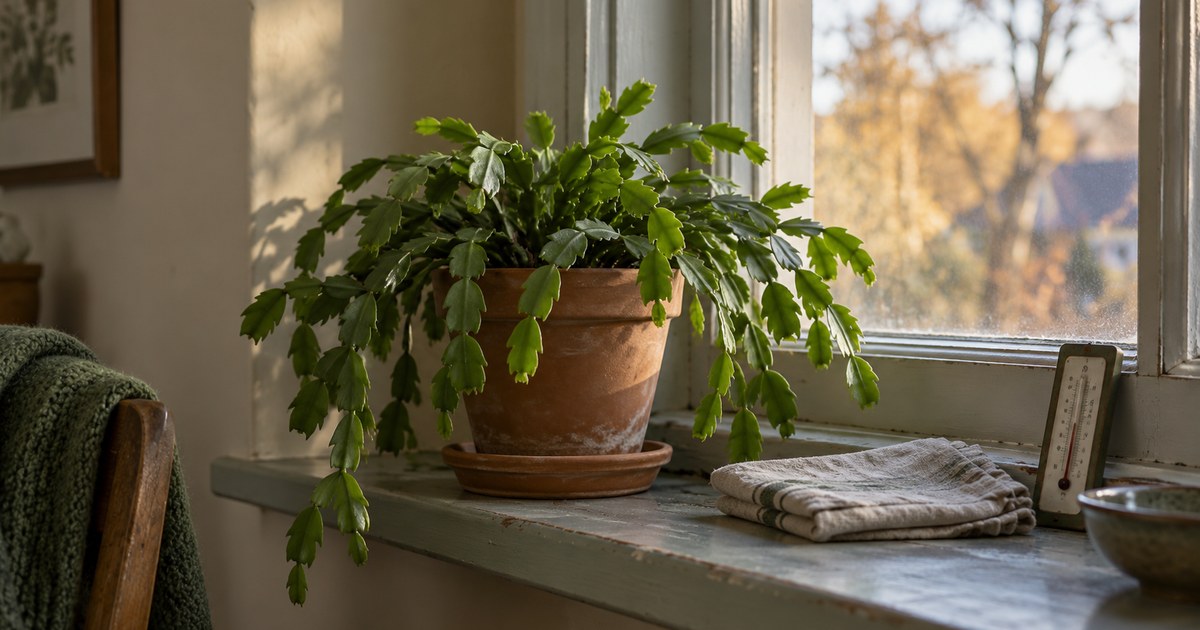
A holiday cactus decides in October and November whether it will flower in December. The three problems people search for in the weeks before the holidays, a Christmas cactus not blooming, buds forming and then dropping, and segments going limp, all have their conditions arriving right now, and all three are easier to prevent this month than to fix next month.
A Christmas cactus not blooming is almost always missing a trigger: about six weeks of long, uninterrupted dark nights, or, for many plants, cool nights in the 50s Fahrenheit. A lamp left on in the evening cancels the first. A warm room cancels the second. Give it one, starting now, and buds usually show in three to four weeks.
The rest of this post takes the three problems in the order they arrive: no buds, buds that drop, and limp growth.
No buds yet: the conditions it is waiting for
Thanksgiving and Christmas cacti are short-day plants. Iowa State University Extension describes them as growing vegetatively in summer and forming buds as the days shorten, and says most species and cultivars need 14 to 16 hours of uninterrupted darkness to trigger buds, though some will bloom with as little as 12. Clemson’s Home & Garden Information Center puts the requirement at 14 hours or more of continuous darkness each day, kept up for at least six continuous weeks, and says buds normally become visible in three to four weeks once conditions are right.
The word that matters is uninterrupted. Clemson says as little as two hours of interrupted lighting will inhibit flower bud set, and that lack of flowering is often due to light interrupting the long night: street lights, car lights or indoor lighting. Iowa State names the usual sources in a home, lamps, kitchen lights and even streetlights. A cactus on the living room windowsill, in a room where the lights are on until eleven, is getting about seven hours of dark, not fourteen.
Temperature is the second route. Clemson says plants grown with night temperatures between 50 and 59 degrees Fahrenheit will set flower buds regardless of day length, though growth slows and some bud loss is possible at 50, and Iowa State says some Christmas and Thanksgiving cacti will bloom if kept at 55 degrees in fall regardless of day length. Warmer than that, the dark nights have to do the work: Iowa State gives 60 to 70 degrees with short days as the ideal, Clemson gives 60 to 68 degrees with as close to 68 as possible for maximum flower production, and Iowa State says above 70 degrees prevents flowering even with short days. The Royal Horticultural Society puts the cut-off lower, saying temperatures staying above 18 degrees Celsius, about 65 Fahrenheit, prevent the flowering response. The sources disagree by a few degrees on the ceiling, and agree that a plant kept in a warm, lit living room all autumn has no reason to flower.
The check. Count the hours of real darkness the plant gets, and read the temperature in its spot at night. A plant in a spare room with the door closed and the heating low is already getting both triggers. A plant on the kitchen counter is probably getting neither.
The change, made now. Move the plant somewhere it gets a long dark night, which can be an unused room, a closet it is carried into each evening, or a corner with a cover over it, and keep it cool. Starting at the end of October still gives buds for the holidays by Clemson’s three-to-four-week figure, with the six-week run finishing in early December. The winter houseplant post covers the rest of the low-light season for the plants that are not meant to be in the dark.
Buds forming, then dropping
Once buds appear, the plant becomes sensitive to change, and this is where the second search comes from. Clemson says Thanksgiving and Christmas cacti commonly drop unopened flower buds, induced by an excessive number of buds or a sudden change in temperature, light or other environmental factors such as the growing medium drying out. Iowa State lists the same triggers: excessive watering, letting the soil dry out too far, moving the plant during bud development, and other marked changes in care. The RHS says bud drop is usually caused by fluctuating temperatures, too hot by day and too cold by night, and that overwatering can also cause it.
The UF/IFAS Extension office in Nassau County answered exactly this question for a reader whose plant had been carried from a porch into the house, and put the bud loss down to the sharp temperature change from outside to indoors, adding that the plant shows damage below 50 degrees Fahrenheit and advising against moving it back out and stressing it again. Clemson adds the opposite limit: do not let temperatures rise above 90 degrees once buds are set, because continuous warmth can also drop them.
The check. Buds dropping within days of a move, a cold snap by the window, the heating coming on, or the pot drying right out point at a change rather than a disease. A plant covered in buds that sheds a share of them is doing what Clemson describes as normal when there are too many to carry.
The change. Once buds show, stop changing things. Leave the plant where it set its buds, away from vents, radiators and cold glass. Watering changes too: Clemson says that following bud set in the fall the growing medium must be kept evenly moist to prevent bud drop, and Iowa State says the same, adding that dryness can cause buds or flowers to drop. UF/IFAS puts it as moist but not wet. This is the one time of year a holiday cactus wants steady moisture, which is why it catches people who were correctly letting it dry through the summer.
Limp, soft or shriveled segments
The third problem looks like thirst and usually is not. Iowa State says that when the plant is dormant, overwatering leads to limp growth and root rot, and Clemson names root rot as the major disease of these plants, prevented by avoiding excessive watering. The RHS describes the symptom from the other side: shriveled stems are often due to root deterioration caused by overwatering or underwatering, or by too much heat or direct sun, and roots may rot if left sitting in damp compost.
The reason this arrives now is the season. Clemson’s advice for spring and summer is to let the soil go dry to the touch between waterings, and the RHS describes rest periods at cooler temperatures with reduced watering. A plant that was watered weekly through a warm summer and is still watered weekly in a cool room in November is sitting in mix that no longer dries, and limp segments on a wet root ball are the result.
The check. Feel the mix and feel the segments. Limp segments on bone-dry mix are thirst, and a thorough drink fixes them within a day or two. Limp or shriveled segments on mix that is still wet from the last watering point at the roots. Tip the plant out: firm pale roots are fine, brown soft roots that pull apart are not. The root rot guide shows what each looks like, and the overwatered plant symptoms post explains why a drowning plant looks thirsty.
The change. Water by touch rather than by calendar from now until buds set, then switch to the evenly moist regime above once they have. A plant with rotted roots needs the dead roots cut away and fresh, free-draining mix. A pot with no drainage hole leaves the roots sitting in damp mix, which the RHS says is how they rot.
Pale, yellowish segments in a sunny window
A smaller fourth problem shows up on plants that spent the summer in sun. Clemson says the holiday cacti grow best in light shade, and that bright sun during the summer months can make plants look pale and yellow; it adds that full sunlight is actually beneficial during fall and winter. The RHS makes the same point, that these are tropical forest plants used to dappled shade, not desert cacti. A pale plant moved into a bright but not scorching autumn window will green up on its own.
The November watch list, in one place
- No buds: give the plant 14 hours of real darkness, or nights in the 50s, starting now, for six weeks.
- Buds dropping: stop moving the plant, keep it away from vents and cold glass, and keep the mix evenly moist from bud set onward.
- Limp segments: check whether the mix is wet or dry before adding water, and look at the roots if it is wet.
Most of this is a change to where the plant lives for six weeks rather than anything done to the plant itself. When a holiday cactus is limp and the mix is somewhere between wet and dry, so that the thirst reading and the root rot reading both seem possible, a photo of the whole plant and one of the roots lets Plant Sickness Identifier weigh the two against each other, and a second scan a few weeks later shows whether the segments have firmed up after the change. The wilting section of the symptom checker covers the same wet-or-dry split for other houseplants.
Sources
- All About Holiday Cacti, Iowa State University Extension and Outreach
- Thanksgiving & Christmas Cacti, Clemson Cooperative Extension Home & Garden Information Center
- Q: My Christmas cactus is losing its buds. What can I do?, UF/IFAS Extension Nassau County
- How to grow Christmas cactus, Royal Horticultural Society