How to get rid of spider mites starts with making sure the damage really is spider mites. Their speckling looks a lot like thrips damage, sunscald or plain dryness, and every treatment works better on a pest you have actually confirmed. The confirmation takes about thirty seconds and a sheet of white paper.
To get rid of spider mites on a houseplant, confirm them first by tapping a leaf over white paper and watching for tiny moving dots. Then isolate the plant, rinse the foliage thoroughly (undersides included), raise the humidity around it, and keep it well watered, because dry, dusty, stressed plants are what mites thrive on. Soap or oil comes after that.
The order matters because spider mites are unusual pests. The conditions they need are specific and fixable, and one of the most common responses, reaching for a general-purpose insecticide, can make them worse.
Are they actually spider mites?
Spider mites are hard to see. UC IPM puts adults at less than one twentieth of an inch long, with eight legs and an oval body, appearing as tiny moving dots to the naked eye. Colorado State University Extension notes that their colors range from red and brown to yellow and green depending on the species. The Royal Horticultural Society adds a detail that confuses people: the common glasshouse red spider mite is usually yellowish green with dark markings in spring and summer, and only turns the orange-red that gives it its name in autumn and winter.
Because they are so small, you usually notice the damage before the mites.
- Stippling. UC IPM says damage first appears as a stippling of light dots on the leaves, and that leaves sometimes turn a bronze color. Clemson’s Home & Garden Information Center describes light-colored speckling on the upper leaf surface giving the plant an overall faded look.
- Webbing. UC IPM notes that dense webbing can cover leaves and twigs when populations are high. Clemson says a silky web is often seen with heavier infestations. The RHS describes a fine silk webbing in heavy attacks.
The white paper test. UC IPM’s detection method is simple: shake a few off the leaf surface onto a white sheet of paper, where their movement is much easier to see. Hold the paper under a leaf or stem that shows stippling and tap it sharply. Specks of dust stay still. Mites start walking. A hand lens helps; UC IPM says they are easily visible with a 10X magnifier.
What else looks like spider mite damage?
The most common mix-up is with thrips. Clemson describes thrips as tiny, slender, yellowish to blackish insects under one sixteenth of an inch, whose feeding creates a silvery or speckled appearance. UC IPM adds the detail that separates them best: thrips leave scabby, silvery to dark brown discoloration and dark specks of excrement on leaves, and the insects are slender, with long fringed wings on the adults. Mite damage is a fine pin-prick stippling without the dark specks, and webbing points toward mites, since none of the extension descriptions of thrips damage include it. The thrips guide has the full set of distinguishing details.
Plain dryness and too much sun can also cause faded, crisp leaves, but neither makes stippling in a regular pin-prick pattern, and neither puts moving dots on your white paper. The spider mites guide lists the full set of lookalikes, and the bugs section of the symptom checker sets the common houseplant pests side by side.
What do spider mites need to survive?
This is the real key to getting rid of them, because the conditions spider mites need are unusually specific.
Colorado State puts it plainly: dry conditions greatly favor all spider mites. It explains why: lower humidity helps the mites manage their water balance, while their natural predators need more moisture and do poorly in dry air. UC IPM adds that mites thrive in hot, dusty conditions and that water-stressed plants are more susceptible. The RHS notes that the glasshouse species thrives in warm, dry conditions and that high humidity and regular misting reduce the risk.
That describes a heated living room in winter, or a plant on a sunny windowsill that dries out between waterings. It is also why spider mites can seem to appear from nowhere: UC IPM notes that a generation can be completed in less than a week at favorable temperatures, so a small population becomes a visible one very quickly.
How to get rid of spider mites, step by step
- Isolate the plant. Mites spread between plants that touch and on hands and tools. Colorado State advises treating all susceptible houseplants at the same time, which is a reminder that the neighbors are probably involved too. Check them.
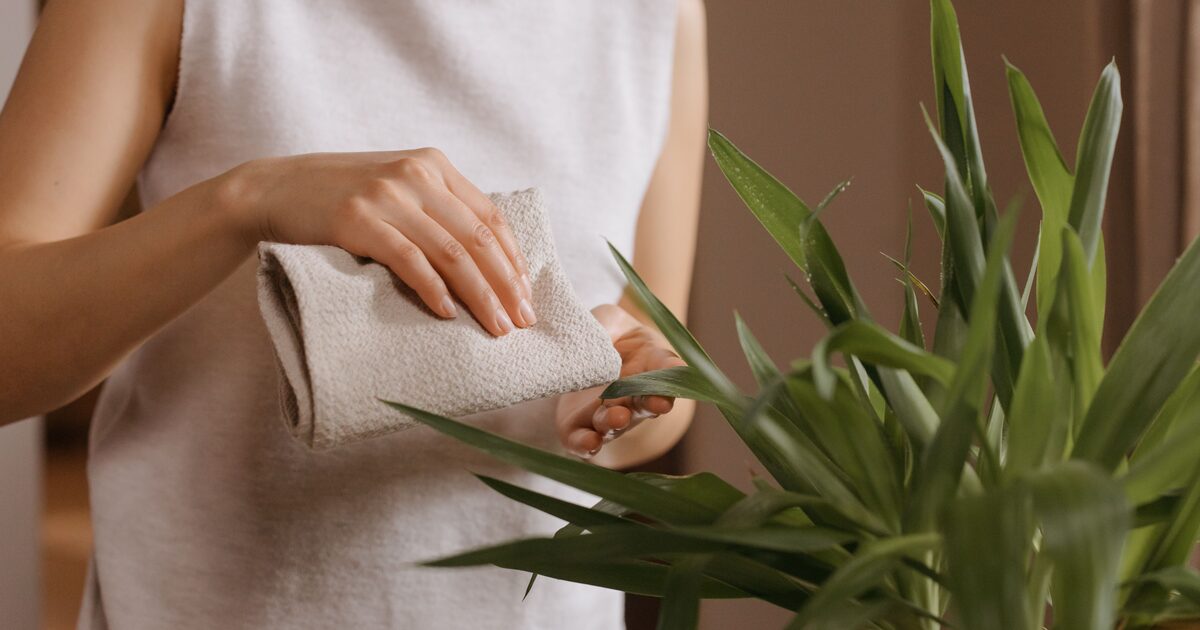
- Rinse the foliage. Colorado State says periodic hosing with a forceful jet of water can physically remove and kill many mites and also remove the dust that collects on foliage. Indoors, that means a shower or sink with the spray aimed at the undersides of the leaves, which is where mites live. UC IPM also lists regular washing with water as a way to reduce mite numbers.
- Change the conditions. Keep the plant watered so it is not drought-stressed, since UC IPM links water stress to worse mite damage. Raise the humidity around it, following the RHS point that high humidity reduces the risk. Move it away from direct heat sources and hot, dry spots.
- Remove the worst leaves. Heavily stippled, webbed leaves are not going to recover and they carry a lot of mites. Bag them before they go in the trash.
- If needed, use soap or oil. UC IPM lists insecticidal soap or insecticidal oil for spider mites, and stresses thorough coverage of the undersides of leaves. It also cautions against applying them to water-stressed plants or in high heat. Rates, repeat timing and product choice belong to the label and your local extension service.
- Consider predatory mites. The RHS describes the predatory mite Phytoseiulus persimilis as the most commonly used biological control for red spider mite, and notes that it is more active than the pest mites it feeds on. UC IPM notes that predatory mites are about the same size as plant-feeding mites but have longer legs and are more active.
Why can insecticides make spider mites worse?
This is the counterintuitive part. UC IPM says that broad-spectrum insecticide treatments for other pests frequently cause mite outbreaks, by killing natural enemies. Colorado State makes the same point about carbaryl, an insecticide it says devastates most spider mite natural enemies and can greatly contribute to outbreaks. So a general bug spray used on a mite problem can clear the predators and leave the mites to rebound. That is why extension guidance leans on water, humidity and targeted soaps and oils.
How do you know they are gone?
Repeat the white paper test every time you water, on the same leaves you checked before. New leaves that grow in clean and green, with no fresh stippling, are the best sign. Old stippled leaves will not turn green again, so judge progress by the new growth rather than by the damaged leaves. And keep the plant isolated until the paper stays clean for a few weeks in a row, because a generation in less than a week means a handful of survivors can rebuild quickly.
The confirmation step is where a photo helps most. Stippling from mites, silvering from thrips and fading from dry air or sun can look alike at arm’s length, and a close photo of an affected leaf lets Plant Sickness Identifier read the pattern and texture of the damage and tell you which it resembles. That settles whether the rinse-and-humidity routine is the right one before you spend weeks on it. The mealybugs post covers the other common houseplant pest that hides in leaf joints.